How to Play the Object 257 Tank Review World of Tanks Year 2019
 USSR (1945) Heavy tank – none built
The IS-7 (Object 260) is ane of the most well-known tanks developed by the USSR, in part due to its massive size and weight, placing it with the likes of Tiger II. However, few know about its lengthy and intricate development procedure, consisting of many years of work and prototypes, with a total of seven unlike prototypes sharing the name IS-7. One of these was the Object 257, the bridging in betwixt the failed IS-6 and the renowned IS-seven.
'Baby' IS-7
In Feb of 1945, a replacement program for the Object 701 (IS-iv), which had merely started development vii months earlier, was requested by the GABTU (Chief Advisers of Armored Forces). The SKB-2 factory, which designed the Object 701, was too busy with information technology and was working on its production. This left a window of opportunity for Factory No.100 to take over and brainstorm work on the IS-four replacement. Factory No.100 had only lost to SKB-2, every bit the Object 252 and 253 (IS-half-dozen) were deemed inferior in many ways to the Object 701. An upgrade to the Object 252, known equally the Object 252U, was fabricated in November of 1944, using pike-shaped angled armor with help of engineers from NII-48 inquiry institute. However, the changes were non able to revive the already canceled IS-6. Despite its failure, information technology served as a good basis for the upcoming heavy tank.
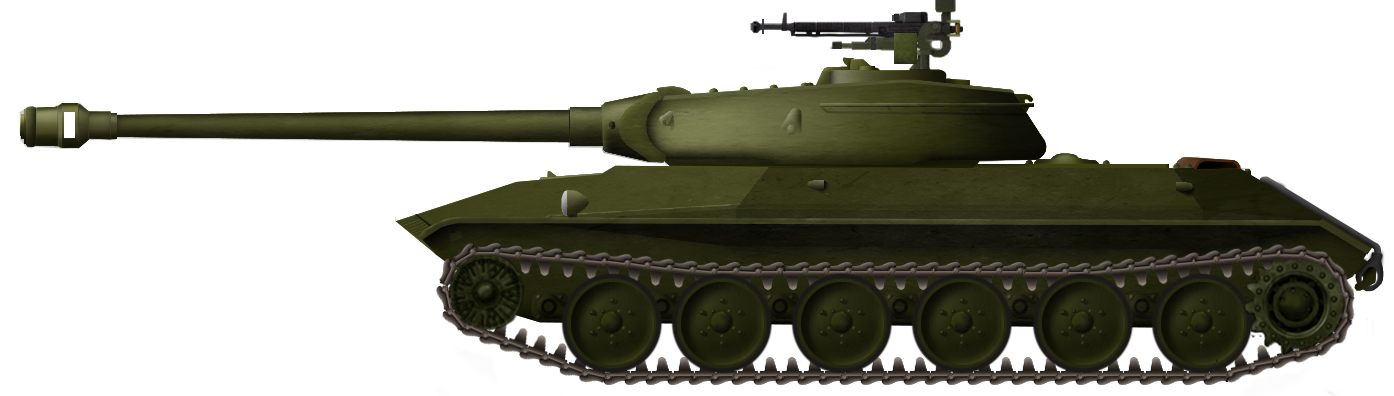
On 7th April 1945, requirements for a 122 mm tank gun with a cage velocity of 1,000 m/s (three,280 fps), ii-part armament, and a rate of burn of four rounds per minute (15 seconds reload) were issued. Manufactory No.100 had already washed work with OKB-172 on the BL-13 gun which was used on the late alterations of the Object 252 and 252U. Earlier prototypes of the IS-vi had the D-30. This new gun was called BL-13-1 and featured improvements over the BL-xiii, such as a mechanical gun rammer, increasing its rate of fire to a whopping 8-ten rpm. Even a mechanical autoloader was tested, merely, despite its claimed solid reliability, it was sluggish and was not worth losing a crew member on. It besides decreased the charge per unit of fire to 7-8 rounds per minute at a college cost tag. Nonetheless, the idea was never fully dropped, equally the final IS-seven prototype used a loading assistant, using a conveyor belt. The shells were however larger, every bit the gun had a 130 mm caliber.
Piece of work started on the new heavy tank in May 1945 with P. P. Isakov, who had previously worked on the Object 252U and IS-2U projects, every bit chief designer. The turret was taken straight from the Object 252U, and and so was the pike-nose design. The engine and manual, rather interestingly, were taken from the Object 253, the IS-vi variant which used a mechanical-electrical transmission, which defenseless fire during trials, was expensive and unreliable. The biggest alter was made to the lower hull and suspension. This project would get the designation Object 257 and was the showtime blueprint to get the proper noun IS-7.
Pattern
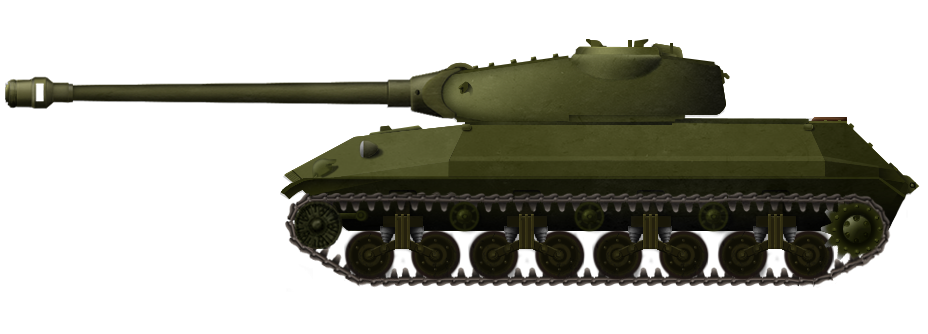
As mentioned earlier, many elements from the IS-6 program were used in Object 257. The turret and pike nose came from the Object 252U and the engine and transmission from the Object 253. Notwithstanding, one of the main focuses of the Object 257 projection was sturdier protection. The aforementioned principle applied on the pike nose, which was implemented on the side of the hull too. The previously flat hull sides were now angled inwards at an extreme angle, forming a diamond shape silhouette from the forepart and rear. On the downside, this caused huge internal problems. Primarily, torsion bars could no longer be used, since the hull was too narrow, meaning that the suspension had to be moved on the exterior of the hull. For the pause, four volute springs were mounted on each bogie, with 2 wheels per bogie, a very like pattern to that of the American M4 Sherman. This made the Object 257 one of the about unique looking Soviet heavy tanks of the postal service-war era, as this was the get-go time a Soviet tank used volute jump suspensions.
The turret was identical to that of the Object 252U, beingness heptagonal and of a depression profile. Within, the gunner was seated to the left of the gun, with the commander behind him. The loader was located to the right of the gun. A coaxial machine gun was besides mounted to the correct of the gun, and could be fired by the gunner. It is unclear if it was a vii.62 mm SGMT machine gun or a 12.7 mm DShk heavy car gun. The loader was responsible for loading this weapon also.

Crew
As the Object 257 focused mainly on protection, crew comfort and overall ergonomics of the tank had to be sacrificed. The pike-like forepart end of the vehicle decreased the corporeality of infinite available for the commuter. Every bit shown in the drawing, the driver'southward pedals would be located high up, his feet being on the aforementioned level as his body. This would have been uncomfortable, specially when driving for longer periods of time. The driver had an entry and get out hatch on meridian of him, however, it was directly under the gun, pregnant that inbound and exiting would have been frustrating when the barrel was over the hatch. To add together to his misery, he only had i periscope, relying more than on the commander for command.
The gunner and commander could sit down on chairs mounted to the floor through a long arm. Even for them, the conditions were not great. The low turret contour gave them very lilliputian headroom, not to mention it restricted the main gun from depressing more than a few degrees. The commander's position lacked a cupola, and only had ane periscope facing forrard and one backward. This further limited his visibility.

The loader was to the right of the gun, having to push the shells in with his left arm, a rather large inconvenience, because the size and weight of a 122 mm vanquish. In addition, the armament was made out of two parts, the beat and the cartridge. In a turret bustle at the dorsum, xxx rounds were stored, protected by an armored case. The cartridges were stored along the sides of the hull, diagonally, meaning that if one cartridge was taken out, another could possibly slide downwardly. This, however, is only speculation. The average loader could load the gun in around 15 seconds. More warheads were stored in the hull, behind the driver. All this meant that the loader could easily load in the warheads, simply had to bend down to grab a cartridge. As indicated before, an autoloader organisation was designed, yet, despite its reliability, it was ho-hum. If an autoloader was used, it is unknown if the loader would have been dropped or he would have had other tasks.
Armor
I of the virtually interesting aspects of this tank is the armor layout. The throughway olfactory organ was an increasingly mutual feature in Soviet heavy tanks of the time. It was 150 mm (six inches) thick, angled at 28° from the side. Yet the lower hull was completely new. Instead of flat plates, similar on the IS-6, the plates were angled inward, forming the same effect equally a pike nose. This would accept helped immensely confronting incoming rounds, deflecting them into the ground. The top parts were 150 mm (6 inches) thick and angled at 30°. The lesser plates were 85 mm (3.3 inches) thick angled at 23°. This thickness was not maintained all the mode to the bottom of the hull. Halfway in, the armor was thinned down to simply xx mm (0.8 inches) nonetheless kept at the same angle. This was most likely washed to salvage weight, equally the chances of enemy fire hit this expanse were rather low, with the big suspensions existence in forepart. The new side armor was bulletproof to the High german 105 mm Flak 39 and the front was fifty-fifty strong enough that the BL-thirteen-1 gun could not penetrate it at bespeak-blank range. The turret armor was thick likewise. The sides, although tinner in some areas, since they were curved, were 150 mm (6 inches) thick, angled at 45° degrees. Of course, this came at a price. The weight of the hull increased to 23 tonnes (25.3 tonnes) over the IS-6'south 21 tonnes (23 tonnes).

Suspension
If there is something that makes the Object 257 stand up out, it is the suspension. As previously stated, the lack of room in the hull meant that the suspension had to be moved on the exterior. Curiously, a bogie with four volute springs per wheel was used. These were very similar to the M4 Sherman medium tank, and it is entirely possible the design was derived from it. The wheels were mounted on opposite sides of the bogie and had artillery on either side. These arms would so be attached to two volute springs that compressed when the wheel moved upward.

Source: The Sherman Tank Site
Engine
Every bit the weight had been increased up to 55 tonnes (60 U.s. ton) on paper, a new engine was needed. Since 1944, Factory no.77 had been working on a new engine, based on the V-2, called V-16F. It was coupled to a like (if non the same) electric transmission used on the Object 253. Withal, this engine was deemed very poor. Trials took place betwixt March and May of 1945 and information technology was establish to be unreliable. Even supercharging the engine to 600 or 750 hp that the IS-vi and IS-4 had would take put a huge strain on the engine, and failures occurred. Fifty-fifty at 520 hp, the engine was faulty. However, an engine this underpowered would have been disastrous if mounted on a 55 tonnes heavy tank, considering a 50 km/h (31 mph) speed was wanted. Farther development was washed on the 5-16F, however, efforts were abased, and improved 5-12 engines were used on the further IS-7 project.

Source: Yuri Pasholok
New German heavies and Conclusion
Subsequently the discovery of the Maus and Jagdtiger and their analysis, the armor on the Object 257 was deemed insufficient. The 128 mm KwK 44 guns of the Jagdtiger and Maus would have pierced the hull. Besides, the armor on the Maus and Jagdtiger was too strong for the BL-13. All this meant that the Object 257 needed to exist reworked significantly. In addition, on 11th June 1945, the requirements of a new heavy tank were set by the GABTU. The weight increased to 60 tonnes (66 U.s.a. tonnes) and the new armament was to exist an Southward-26 130 mm gun. Lastly, torsion bar interruption was required. The Object 257 conspicuously was not adequate, leaving mill No.100 to start piece of work on a new heavy tank. Notwithstanding, work was non in vain, as the experience gained and armor features of the Object 257 were passed on. Many other tanks were designed, until the final Object 260 was made, the IS-7 we know today.
Sources
https://warspot.ru/2793-elektrostalin-6
https://warspot.cyberspace/ix-object-257-the-outset-is-7
http://www.tankarchives.ca/2019/03/modernization-on-newspaper.html
Object 257 specifications | |
| Dimensions (L-W-H) | 7.375 x 2.430 x iii.390 meters (24 x nine 10 11 feet |
| Total Weight, Boxing Set | 55 tonnes (60 United states of america tons) |
| Crew | 4 (Commander, Gunner, Loader and Driver) |
| Propulsion | V-16F engine and electrical transmission |
| Speed | fifty km/h (31 mph) |
| Armament | 122 mm BL-xiii-1 two-office ammunition gun co-axial seven.62 mm SGMT machine gun |
| Armor | Hull armor Front top plate: 150 mm at 28° Front bottom plate: 150 mm at 40° Side top plate: 150 mm at 30° Side lesser plate: 85 mm & 20 mm Turret armor Front: 150 mm Side: 150 – 120 mm Rear: 100 mm Tiptop: 30 mm |
| Total Production | 0; pattern only |
Source: https://tanks-encyclopedia.com/object-257/

Post a Comment for "How to Play the Object 257 Tank Review World of Tanks Year 2019"