Art Lessons Kindergarten Students Can Do on Their Own
 Liv Ames for EdSource
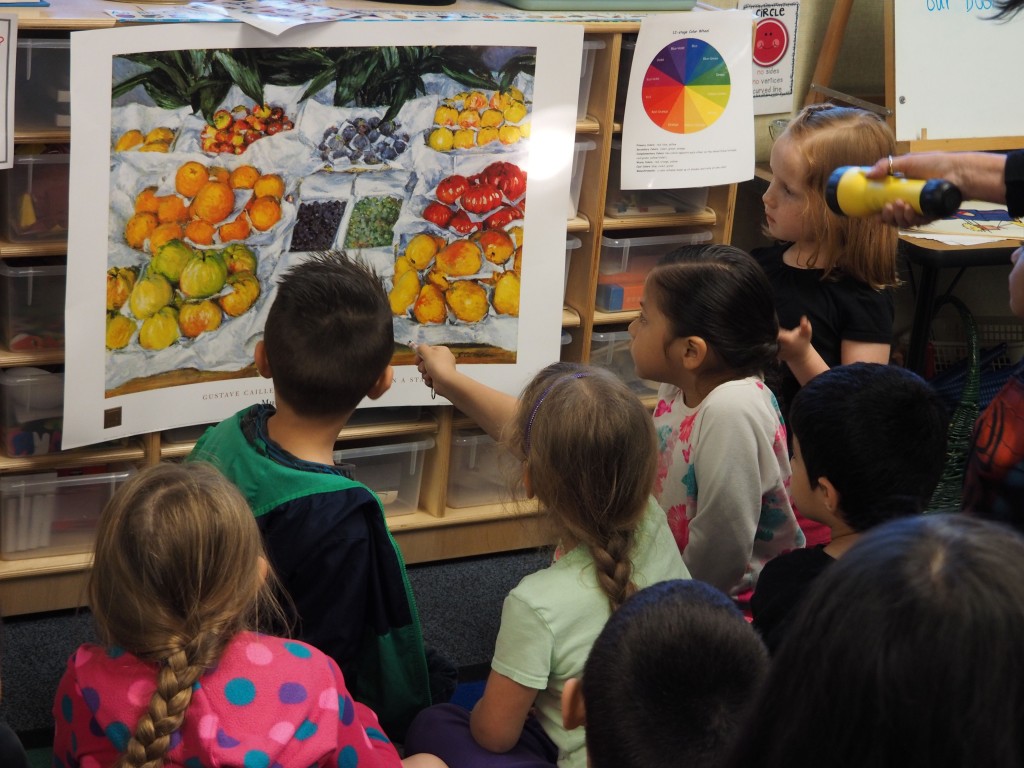
Transitional kindergarten students discuss 19th century French creative person Gustave Caillebotte'due south painting "Fruit Displayed on a Stand" at Figarden Simple School in Fresno.
Art lessons for pre-kindergarten students are moving beyond finger paints and into the worlds of van Gogh, da Vinci and Rivera.
Teachers in a number of districts in California are using classic works of fine art to inspire some of the youngest students to notice closely, think critically and talk over respectfully – all key elements of the Common Core approach to learning.
Past looking closely together equally a form at a Picasso or a Cezanne, iv- and 5-year-olds are learning how to observe and translate their thoughts into language and heed and answer to multiple perspectives.
This arroyo for Grand-12 students was developed about twenty years ago by the co-founders of Visual Thinking Strategies, a nonprofit based in New York that provides training in the method to schools and fine art museums. More recently, the nonprofit has introduced the concept to pre-K classes.

Liv Ames for EdSource
Alexander Chitay, a transitional kindergartner, uses a light amplification by stimulated emission of radiation light to point out what he wants to hash out about the painting.
It appears to be growing in its appeal since the introduction of the Common Cadre standards adopted past California and 42 other states. During the past two years, the nonprofit's national trainings of educators take doubled, said Amy Hunt Gulden, national plan director. The nonprofit has trained teachers in more than 70 schools in the Bay Expanse, Northern California and Los Angeles.
Inquiry studies on the method accept shown that students in classes where the visual thinking programme was used had a better understanding of visual images, exhibited stronger growth in math and reading, and showed amend social-emotional growth than students in classes that did not utilize the plan. The approach was peculiarly constructive for English learners.
The visual thinking method asks three questions of young students: What's going on in this picture? What do you see that makes you say that? What more can nosotros find?
This approach teaches students how to have the fourth dimension to observe closely, draw what they see in detail and provide evidence for their observations, Gulden said, "the kinds of skills that the Mutual Core asks for."
Such programs are part of a new movement in English language linguistic communication arts to develop visual literacy, said Kim Morin, a professor who teaches integrated fine art at Fresno Land Academy.
"It kind of came in with the Common Core – a more than holistic approach," Morin said. "As society becomes more digital, it'south not plenty to but be able to read words; we have to be able to read images."
"We accept to be able to expect at an image and sympathise information technology, not just react to information technology," she said.
Some districts, such as San Francisco Unified, were applying this method long before Common Core standards were adopted. When Elizabeth Levett, who teaches kindergarten at George Peabody Elementary in San Francisco, introduced the Visual Thinking Strategies program into her classroom nearly eight years ago, she said she saw the growth in her students' language "right abroad from one lesson to the next."
"They'll start the year with 'I come across a ball,'" she said. "After that it snowballs. It'south amazing."
"We're giving them language they wouldn't normally have in a context that is meaningful to them right in the moment," said Elizabeth Levett, a kindergarten teacher at George Peabody Elementary in San Francisco.
Teachers answer to a student'southward comment on a painting by paraphrasing the comment and taking it to the next level, Levett said. Perhaps a student will notice a effigy. The instructor will then say, "then you are noticing this figure in the left-hand foreground of the painting?"
"We're giving them language they wouldn't ordinarily have in a context that is meaningful to them right in the moment," she said.

Liv Ames for EdSource
Donavon Quezada, 4, is looking closely at a painting in his transitional kindergarten class in Fresno.
Information technology is important for the teacher to paraphrase the educatee's annotate in such a way that the educatee feels understood and the rest of the grouping tin grasp what the educatee has said, Gulden said. Teachers accept to permit get of their agendas and ideas and follow the child, she said, another Common Cadre approach to learning.
Sometimes the student may be searching for a word and the teacher can restate the educatee'southward idea using the give-and-take, she said.
The arroyo "builds vocabulary and fluency," Gulden said. The method is particularly effective with contempo immigrants, she said.
School psychologist Julie Montali as well finds the method works well with English learners. Montali has an fine art caste and has been trained in the visual thinking method. She developed a similar curriculum for pre-K students at Fresno Unified with English language arts instructional bus Claudia Readwright.
"Kids deed as linguistic communication models for other kids," Montali said. "Ofttimes some other child is the best teacher."
The open-ended approach to discussing the painting also equalizes the experience, she said. The art is new for everyone, sometimes including the teacher. The word of the ideas inspired by the art does not require prior knowledge, and there are no wrong answers. That makes information technology easier for shy students or those learning English to participate, she said.
Children besides answer to the ideas of other students and learn to expect at things from another person'due south perspective, Montali said. They keep the discussion moving with minimal intervention from the teacher, the kind of cocky-directed learning emphasized past the Mutual Cadre.
In the process of discussing the paintings, the children learn how to have different opinions without rancor, Levett said. They use terms such as "I'grand noticing" or "I want to build on what he said."
Juliet James, who has been using the method to teach 2nd-graders at Erstwhile Adobe Elementary School in Petaluma for the past five years, said students are polite. "They'll say, 'I disagree with Karen because of this reason.' They accept to give the evidence," she said.
Using high-quality artwork is as well important, Morin said, particularly in terms of stimulating observations past the children.
"You tin go on going back to a masterwork and see something different every fourth dimension," she said. "If it's not a loftier-quality piece of work, it doesn't have that depth."

Liv Ames for EdSource
Students in a transitional kindergarten class in Fresno talk among themselves about the work of art they just discussed every bit a grade.
On a recent day, the transitional kindergarten students in Yvonne Stout-Barrett's class at Figarden Unproblematic School in Fresno eagerly gathered around a print called "Fruit Displayed on a Stand up" by the 19th century French artist Gustave Caillebotte. They began talking nearly what they saw, including shapes and colors. Building vocabulary by discussing shades such as magenta, carmine or chartreuse is one way talking about art builds more sophisticated linguistic communication.
Teachers say they run into the issue of the method in other subject areas.
Brian Harrigan, who teaches preschool students at San Francisco Unified, said that since he has used the visual thinking method, he notices the difference when he is reading a story to the children.
"They starting time describing things in the picture more fully," he said.
Such close observations of art help children learn to visualize, which helps them when they begin to read, Morin said. "If you tin visualize what you are reading, you lot are a stronger reader rather than only reading discussion-to-word," she said.
The same methods of showing prove for what you are thinking or saying tin work with deconstructing a story or a mathematical graph, Gulden said.
James uses the method in educational activity all subjects to her 2nd-graders, such as when she introduces the 100s number chart to discuss place value.
"They will talk virtually it being a grid, how each space is equal," she said. "They will discover the numbers going across are ane to 10. I and then come in and say that the horizontal numbers are one to 10. And so they will notice the vertical numbers are counting by 10s."
"Very ofttimes young children have an almost deeper perception of what they're seeing," said Fresno Land professor Kim Morin. "They don't have preconceptions. They don't remember: 'I don't get it.'"
Fresno has decided to implement the curriculum past adding information technology to a grade each year, beginning with preschool children last year and transitional kindergartners this year. The integrated approach will follow the children as they move through the Grand-12 system.
Starting immature has its advantages, Morin said. "Very oft immature children have an nearly deeper perception of what they're seeing," she said. "They don't have preconceptions. They don't think: 'I don't become it.'"
In a research paper on talking about art with young people, David Bong, an associate professor at the Academy of Otago in New Zealand, says that "children are less inhibited than many adults in their appointment with artworks."
"They may be surprised, entertained, puzzled or challenged by what they run into," he said. "They are also probable to limited their diverse responses to the works in exclamations, comments or conversations."
Teachers laud the method for slowing things down in a fast-paced globe and building on immature children's natural ability to learn through observing.
"Everyone is worried about kids having access to technology," Levett said. "They're as well niggling. They need to acquire how to wait slowly, really discover. Everything in engineering is click, click, click. This method hones the arts and crafts of looking securely and actually listening to each other."
To get more reports like this ane, click here to sign up for EdSource'south no-price daily electronic mail on latest developments in education.
Source: https://edsource.org/2015/art-appreciation-helps-young-children-learn-to-think-and-express-ideas/77734

Post a Comment for "Art Lessons Kindergarten Students Can Do on Their Own"