The French Revolution Begins Guided Reading Workbook Pdf 23.1
History
French Revolution
The French Revolution, too known as the Revolution of 1789, was the revolutionary movement that shook France between 1787 and 1799 and reached its kickoff climax in 1789. Hence the conventional term "1789 Revolution", which denotes the end of the One-time Authorities in France and as well serves to distinguish that upshot from the later French revolutions of 1830 and 1848.
- When was information technology: From 07/14/1789 to 09/11/1799
- Where was it: France
What was the French Revolution?
Information technology was a revolution that marked the end of a historical era and the get-go of the contemporary age, it marks a dividing line between the Aboriginal regime and the French Revolution: the monarchical absolutism that governed feudal guild.
- Summary
- Characteristics of French Revolution
- Causes
- Aims and Objectives
- Stages
- Near important facts
- Consequences
- Achievements
- Impact of French Revolution
- Leaders and characters
- Symbols
- Women during the French Revolution
- Social classes during the French Revolution
- Phrases
Summary
The French Revolution ended the system of absolute monarchies of the European countries, which was based on the principle that all powers resided in the male monarch, who was the source of all power by divine right; such right was the legal and philosophical basis of his sovereignty.
The French Revolution separated these powers, making the legislative power belong to an Assembly or Parliament; the executive power to the king and his ministers, or in a government in the republics; and the judicial power in the courts of justice.
In short, information technology would seek to eliminate the monarchy or let information technology exist absolute to become a political arrangement in which they would control each other. It was also understood that sovereignty did not come but from the people, who delegated the do of ability to freely elected rulers in periodic electoral processes.
Characteristics of French Revolution
The master characteristics of the French Revolution were the following:
- It created a new model of society and country.
- With it came the analogy that gave a new faith to reason and progress.
- The rights of men were affirmed.
- Popular participation of people began.
- The castles were looted and destroyed.
- Fiscal extensions were eliminated.
- The ideals of freedom, equality and fraternity were formulated.
- The feudal organization and the privileges of the clergy were eliminated.
Causes
There were several causes for French Revolution, among them are:
- Economical: the principal causes inside the sphere of the economy were the fiscal deficit, the economic crisis, the debt owed past the State and the rise in prices without product control.
- Social: there was opposition to the privileges enjoyed past the revenue enhancement reform and the bourgeoisie wanted to gain admission to power. The popular classes began to emerge every bit an opposition force in the face of these situations. The almost privileged were categorically opposed to paying new taxes and for this reason they rebelled against the increase.
- Politics: The Enlightenment and its ideals began to exist generated, and an attempt was made to follow the case of U.S. independence.
Aims and Objectives
The main objectives of French Revolution were:
- To put an terminate to the monarchy.
- To eliminate the feudal system and excessive privileges and inequalities.
- Build a more modern country.
- Declare the rights of man and citizens.
- To create the French Democracy.
- Separate the powers of the State and plant sovereignty.
Stages
The French Revolution lasted 10 years and its phases were as follows:
- Meeting of the General States in 1789: the monarch Louis XVI summoned the representatives to the assembly. The clergy, the nobility and some people' representatives discussed aspects such equally misery, crunch, bad harvests and hunger.
- National Assembly and revolt of 1789 and 1791: the people and members of the bourgeoisie requested the private vote without results and when they were rejected, they constituted the National Associates as the maximum representation of the nation.
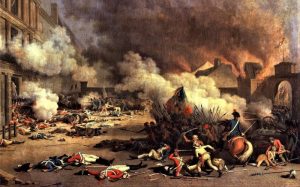
- Taking of the Bastille in 1789: on July 14 of that twelvemonth, the Guardhouse that was a prison was taken past the people facing the danger that the bourgeoisie would eliminate the assembly. This was the official beginning of the French Revolution. The National Associates became a National Elective Assembly abolishing bullwork and its rights and privileges. The rights of man were published with the ideals of equality, fraternity and freedom.
- Legislative Assembly of 1791 and 1792: people followed discontent and the strongest ideas of revolution.
- The convention and the republic: the French monarchy falls when the people attack the Tuileries palace finding a serial of documents that proved their expose. The first elections were held by universal suffrage, in which only men participated.
- The Directory: the quango of elders is created and the Five Hundred by popular election. These chambers were dominated by the conservative bourgeois grade and implemented policies that annoyed the people. Napoleon Bonaparte carried out a coup d'état and was later appointed first consul.
Most of import facts
Among the most important facts we can mention:
- The monarchies were eliminated.
- At that place was the separation of church and state.
- It was passed from the monarchic absolutism to the parliamentary type monarchy and to the Republic.
- The executive, legislative and judicial powers were created.
- The seizure of the bastille and the announcement of homo rights in 1789.
- Constitution of 1791 and the rex'due south escape.
- The coup d'état of Napoleon in 1799 which puts an terminate to the revolution.
Consequences
The abolition of absolute monarchy in France was a directly consequence of the process which succeeded in putting an end to the privileges of the aristocracy and clergy. Servitude, feudal rights and tithes were eliminated; property was disintegrated and the principle of equitable distribution in the payment of taxes was introduced.
The principles of freedom of worship and freedom of expression written in the Declaration of Human Rights were established, freedom of conscience and ceremonious rights for Protestants and Jews were initiated.
The first Constitution was formed, and the ecclesiastical goods were eliminated so that, they were passed on to the nation to solve economical problems.
Achievements
Among the well-nigh important achievements of the revolution nosotros can mention that important changes were made in European politics, it was a social model that transformed the economy and the office played past social classes. Enlightenment ideas triumphed over the monarchy and the Us was born creating a new political arrangement.
Impact of French Revolution
Its impact was enormous, its ideas, values and the model that emerged from it spread worldwide and are however being practiced. It influenced homo rights, democracy and the shaping of today's world. The new policy he created based on political change through voluntary activity and the movement of the masses reached unlike countries that were already fighting colonialism to achieve independence.
Leaders and characters
- Louis XVI of France, who was the male monarch of France and who was overthrown and beheaded.
- Marie Antoinette: Queen of France who exerted a keen influence ignoring the misery of the people.
- Charles X: younger brother of Louis 16.
- Anne-Robert Jacques Turgot: French economist and politician who enshrined economic and social reform.
- Jacques Necker: one of the most notable bankers of the time.
- Voltaire: writer and disseminator of the secular creed that guided the theoreticians of the Revolution.
- Maximilien de Robespierre: political leader who established the government of Terror.
- Marquis de la Fayette: French soldier and pol who exercised a liberal political credo.
Symbols
The most used symbols during the French Revolution were:
- The Phrygian cap: it was a symbol of freedom and was consecrated as a symbol of freedom and republicanism.
- The Marseillaise: current anthem of France that began as a song of revolutionary war and freedom.
- The guillotine: car used for decapitation.
- La Cocarde: symbol representing the wedlock of the people and the rex.
Women during the French Revolution
It was very intense, although this story is not told. The women fought for the feminist demands and their social status because they knew what food cost and the difficulties in getting their families through. Their struggle bore results in the summertime of 1793, when they achieved political equality in the sections, assemblies and pop societies. Some of them were:
- Olympe De Gouges
- Mary Wollstonecraft
- Clergy: they were the first social grade and had enormous wealth and influence over France. Information technology was divided into high and low clergy.
- Dignity: they were descendants of the feudal lords and had large extensions of payment of which they did not pay taxes past exploiting the peasants.
- Patently State: known as the Tertiary State and made up the great bulk of the population of France. They had no privileges, paid many taxes and suffered hunger and misery.
- Peasantry: workers who worked in the fields for the feudalists, worked a lot and earned very little.
Phrases
Amid the nearly recognized phrases that emerged during the French Revolution we mention:
- When people rebel, we do not know how they will exist able to return to calm, and when they are at-home, we do not understand how revolutions can take identify.
- The revolution does not cull its paths: information technology took its first steps towards victory under the abdomen of a Cossack'south horse.
- Oppressed people have the right to ascension upward and break their chains as soon as they tin.
- All men recognize the right to revolution, that is, the correct to refuse obedience and to rise upwardly against the authorities when its tyranny or incompetence is groovy and intolerable.
Written past Gabriela Briceño V.
Source: https://www.euston96.com/en/french-revolution/

Post a Comment for "The French Revolution Begins Guided Reading Workbook Pdf 23.1"